Express Login
 Contact Us
 RMU Login
 Customer Portal

Days on market (DOM) tells you what already happened. But what if you could predict which properties will struggle to lease before they hit 30+ days vacant?
The answer lies in your leasing data. Tracking basic metrics like DOM and lead counts is useful for monitoring things as they unfold, but strong predictions come from analyzing conversion rates, lead quality, and pricing patterns.
One of Rent Manager’s integrated providers, RentEngine, recently analyzed leasing data from thousands of properties, tracking everything from conversion rates to communication patterns. This blog will dive into which metrics are most helpful for making accurate predictions about your properties.
Let’s discuss some key points to analyze beyond just DOM.
Start with Conversion Rates
It’s easy to get excited about a property with 50 leads in the first week. However, if only two prospects schedule showings, you likely need to make some changes.
Conversion rates tell you how well leads move through each step of your leasing process. Think of it like the traditional sales and marketing funnel:
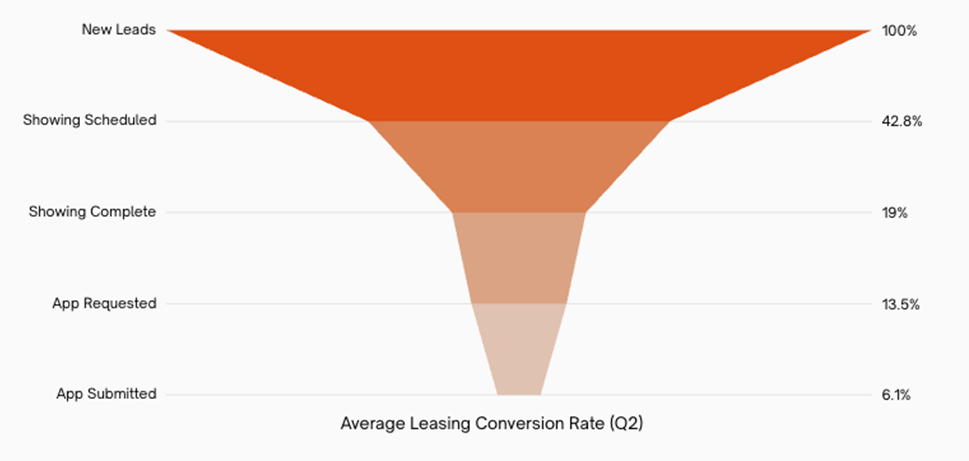
- Leads become scheduled showings
- Scheduled showings become completed showings
- Completed showings become applications requested
- Applications requested become applications submitted
Data from RentEngine’s Q2 report shows that about 6.1% of leads ultimately submit applications, meaning roughly 94% of leads don’t convert. Understanding at what point prospects drop off in the funnel helps you focus your efforts.
When a property has low conversion rates after the first week, it’s usually a sign of:
- Overpricing
- Poor photos or listing description
- Unresponsive lead follow-up
- Showing availability issues
Track these rates weekly for each property. If your lead-to-showing rate drops significantly below your baseline after the first week, investigate immediately—don’t wait until you’re at 25 days on market.
Use Days Since Price Change, Not Total Days on Market
Here’s another problem with using only DOM as a metric: it penalizes properties that started overpriced.
A property priced at $2,200 that sits for 20 days, then drops to $2,100 and rents in 5 days didn’t really take 25 days to lease. It took 5 days at the right price.
Track “days since last price change” alongside total days on market. This metric reveals your true leasing velocity once pricing is correct.
The data around rental price reductions shows:
- Properties needing price reductions average 4.6% ($88) in decreases
- Each price reduction adds approximately 10 days to lease time
- Properties priced correctly from day one average 20 days on market vs. 30+ for those that require multiple reductions
The cost of overpricing isn’t just the rent reduction, it’s also the lost rental income during those extra days vacant.
Benchmark Against Market Performance
You can’t improve what you don’t measure against a baseline. Do your research to understand whether your average performance is good or bad relative to the local market.
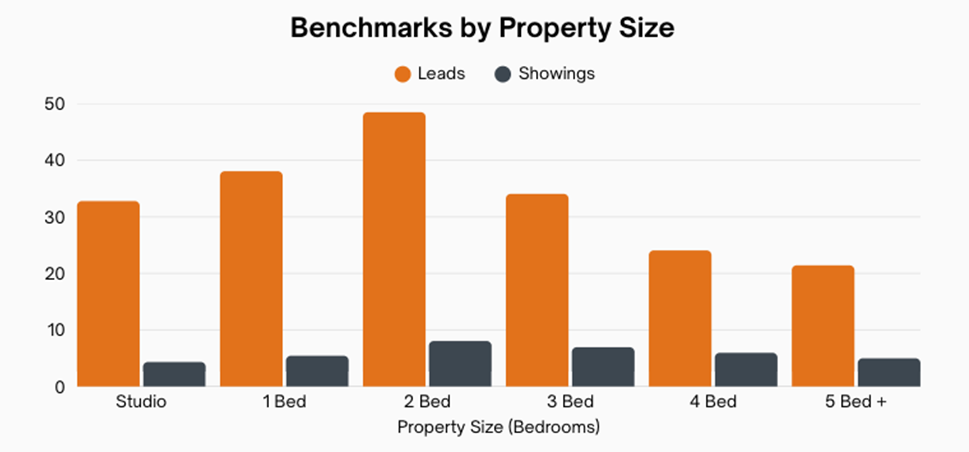
Key benchmarks to track:
- Lead volume by bedroom count: Two-bedroom properties typically generate 40-50 leads over their rental cycle
- Conversion rates by property type: Larger properties (4+ bedrooms) often convert at higher rates due to limited supply
- Time on market by showing type: Self-guided showings often lease faster than agent-accompanied showings
- Application volume: Properties in the $1,000-$1,500 range see the most activity but the lowest conversion rates
In this instance, if your two-bedroom property gets only 20 leads after two weeks, that’s a key indicator of potential problems ahead.
Of course, these numbers are averages across a large dataset and may not accurately reflect your area. For the best results, track data for listings in your area to nail down benchmarks that are true to your locale.
Not All Leads are Created Equal
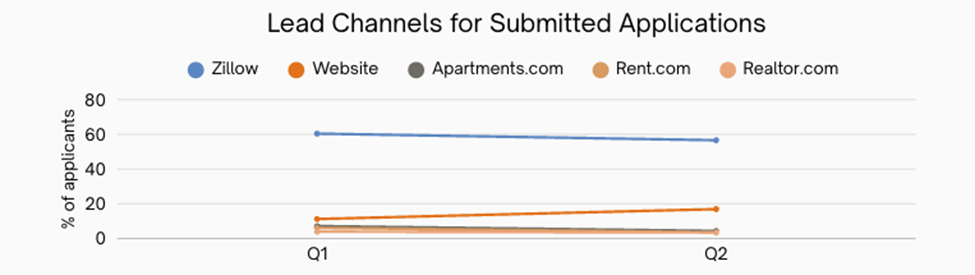
Lead volume means nothing without context. Track where your best applicants come from, not just where you get the most leads. If you’re spending marketing budget on a channel that drives high volume but low conversions, redirect that spend.
About 20% of leads will consider multiple properties from the same property manager. When someone inquires about one property, show them two to three similar options. This simple cross-selling can turn one lead into multiple opportunities.
Track Communication Patterns of Successful Applicants
Not all prospect communication is worth your time.
Before showings, qualified prospects typically:
- Send 1.3 text messages on average
- Ask basic questions about availability and showing times
- Rarely call (only 25% make phone calls before showings)
After showings, serious prospects become more engaged:
- Ask detailed questions about lease terms, policies, and neighborhood
- Are more likely to call with specific concerns
- Respond quickly to follow-up messages
If you’re seeing similar patterns, focus your team’s energy on post-showing follow-up.
Use Your Property Management Software’s Reporting
The best platforms centralize all your critical reports in one place rather than forcing you to jump between multiple tools.
Look for systems like Rent Manager that offer comprehensive reporting across:
- Property Performance: Track leads, applications, and conversion rates with automatic health scoring
- Lead Pipeline: Monitor lead sources and prospect status across your entire portfolio
- Showing Analytics: Analyze completion rates, feedback patterns, and agent performance
- Prescreening Data: View approval rates, income verification, and credit score trends
- Communication Tracking: Monitor call volumes, response times, and text engagement
- Syndication Health: Ensure listing accuracy across all marketing platforms
Start Small
Don’t try to analyze everything at once. Begin with these three metrics:
- Lead-to-showing conversion rate by property
- Days since last price change
- Lead source performance
The goal isn’t to become a data scientist, but to spot problems early and make small adjustments that compound into better results.
Your leasing data contains the roadmap to faster leasing and better owner relationships. You just need to know where to look.